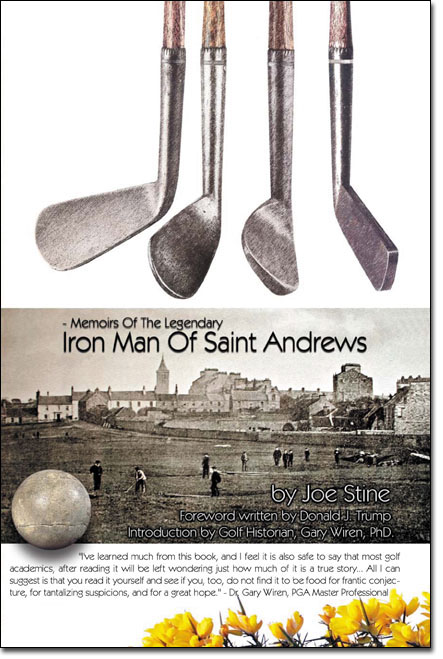
 Available in Paperback, 254 Pages $17.99
[Watch in Full Screen Mode]
Available at Amazon.com
Book Introduction: By Gary Wiren, PhD., Golf Historian, PGA Master Professional
Memoirs of the Legendary Iron Man of St. Andrews is an extraordinary historical novel (based on true events) that ventures a guess as to the identity of a real-life historical figure known to golf collectors as the ‘Ringmaker’. Certified by scholars as the maker of very distinguishable hand-forged circa 1800 golfclubs, the actual name of this ancient blacksmith is not known. His work, however, is easily recognized by an ornamental ring cut around the top of the clubs’ hosel, subsequently collectors and museum curators worldwide simply refer to him as “The Ringmaker”.

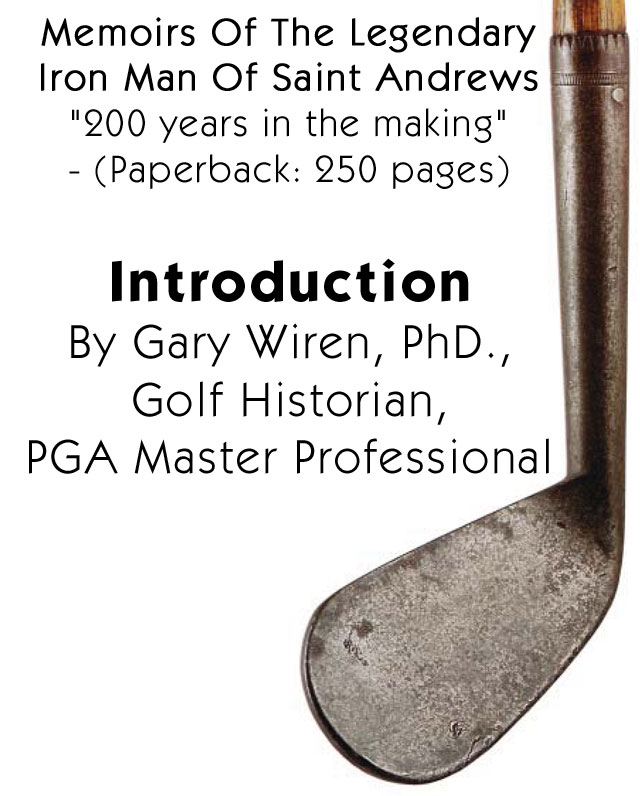 This photograph of a circa 1800 "Ringmaker" iron golf club is from the book, "The Clubmaster's Art, Antique Golf Clubs And Their History" by Jeffery B. Ellis.
Besides the club pictured here, six other examples of the Ringmaker's work are ‘currently’ known to exist. One of the six other early irons that share this distinctive ring was formerly the property of Perth Golf Club in Scotland. It is nearly identical to the one pictured here and in the year 2000 it sold at a Phillip auction in England for just under $40,000.
Another of the six irons is quite similar, except that its hosel is pinned “heel to toe” instead of front to back. A third “Ringmaker” iron, property of the Royal Musselburg Golf Club, is one of the earliest putting irons known. Another of the six is a cleek or driving-iron. The fifth and sixth “Ringmaker” irons, formerly owned by the Woking Golf Club in Surrey, England, were sold in London at Sotheby’s golf auction in July 1996.
In the writing of this book, the author shows us a sure grasp of the material and manages to pull the innumerable and far-flung threads neatly together. At times while reading, I found myself pondering if perhaps the memoirs chronicled within this manuscript might be more genuine than not.
As the categorization ‘historical novel’ implies, The Memoirs of the Legendary Iron Man of St. Andrews is classified as a work of fiction, but speaking as a golf historian I can attest that as a whole, the historical accuracy of this extraordinary book is uncanny. For instance, the second chapter of this book makes mention of a chance meeting between the famed author, Sir Walter Scott and a very young Iron Man on the sixth birthday of his best chum, wee Tom Morris.
Fascinated by the implications of this revelation I spent a significant amount of time researching the facts and found that Sir Walter Scott did indeed make three known visits to St Andrews, once in 1793, again in 1823 and a third in 1827. What’s more, to my astonishment Scott’s own journal for Saturday, June 16th, 1827, (Tom Morris’ sixth birthday) records his third known visit to St. Andrews in great detail, identically paralleling the facts entailed within this book.
There are certainly many other instances of factual details within the provocative memoirs that appear seemingly impossible to contrive, such as Chapter Twelve’s detailed description of the inner sanctum of the ultra-private Old Union Parlor in 1846 St. Andrews. Equally as fascinating, the tragic and powerful story of the British and Chinese Opium Wars of Queen Victoria’s era also comes to life through the frequently macabre and deeply unsettling conversations that take place within the Old Union Parlor.
In regard to the state of the two early 19th century golf courses depicted within this meticulously presented novel, the author paints an historically accurate picture capturing the imagination of the reader and carries it through the great fields of heather and gorse that make up the Old Course at St. Andrews in 1854, as well as Prestwick’s original 12 hole layout.
In summation, I find myself compelled to say that I have learned much from this book. And I feel it is also safe to say that most golf academics, after reading it will be left wondering just how much of it, if any, might be less-than-factual. All I can suggest is that you read it yourself, and see if you, too, do not find it to be food for frantic conjecture, for tantalizing suspicions, and for a great hope.
- Dr. Gary Wiren, PGA
 Available on Kindle $12.99 at Amazon.com